Batch Cooking in Brussels: 5 Mistakes That Waste Sunday
By Thomas · 2026-04-23 · Meal Prep
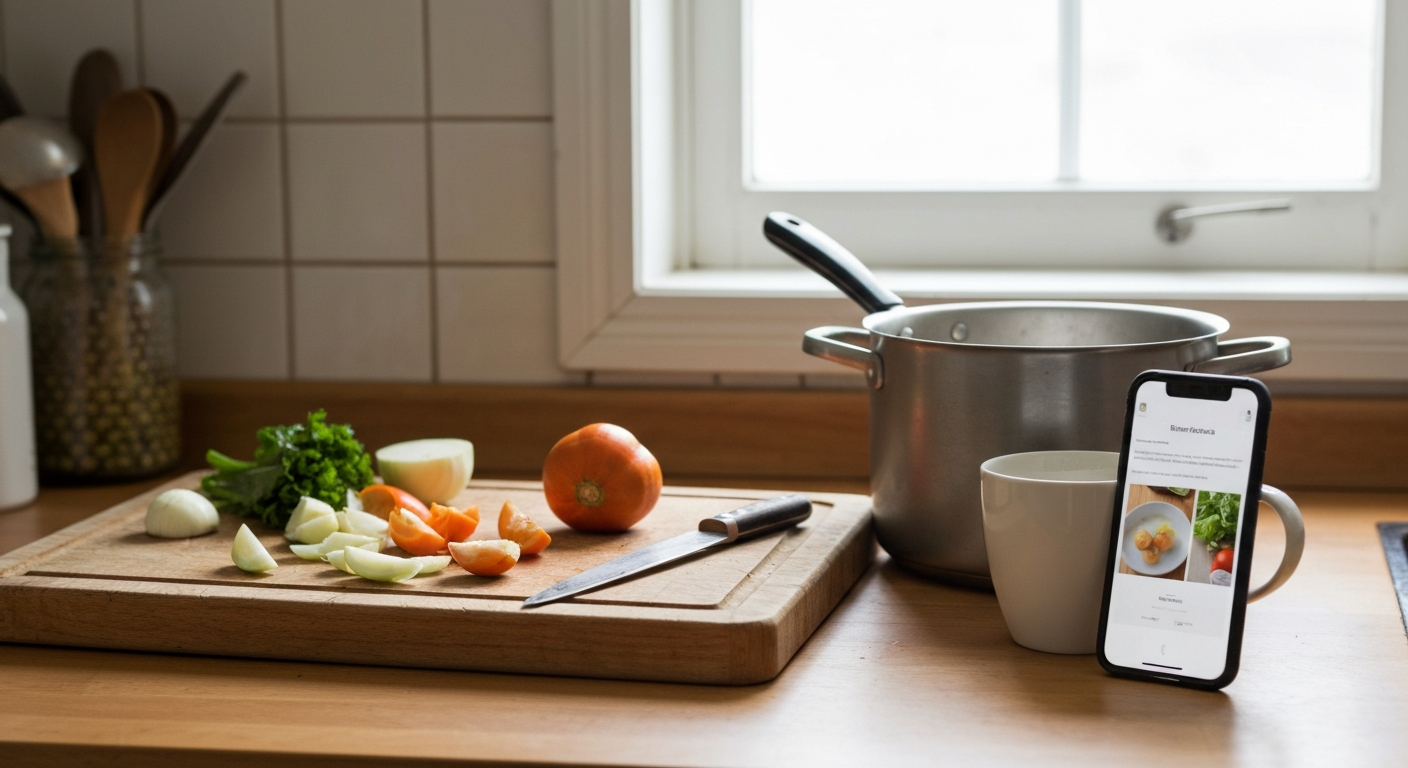
Batch cooking is supposed to be the Brussels professional's secret weapon: one calm Sunday afternoon, a week of dinners handled. In practice, in the cramped kitchens of an Ixelles studio or a Saint-Gilles maison de maître, most people who try it on their own give up within three weeks. The reason isn't laziness. Home batch cooking has five specific failure modes that nobody warns you about, and when two or three hit at once your Sunday becomes a punishment. Here are the five, why they happen, and what to do instead.
Mistake 1: Wrong containers for a small Brussels kitchen
The first thing that ruins batch cooking is plastic containers that warp in the dishwasher, lose their lid seal after two months, and stain orange after one tomato sauce. By week four you have a stack of mismatched lids, a bottom drawer of crooked rectangles, and a daily moment of frustration when nothing closes. In a small flat where the fridge is half the size of a London or suburban one, stackability matters even more. Glass containers with locking lids cost about €5 each at any GB, Carrefour or Action and last for years. Eight of them is enough for a week. The starting investment is around €40, which sounds like a lot until you count the eight plastic boxes you'd have replaced in the same year.
Buy two sizes only: a deep one for soups and stews (around 1 litre) and a flat one for plate-style meals (around 700 ml). Mixed sizes that don't stack will frustrate you within a month, and in a Brussels fridge they cost you shelf space you don't have.
Mistake 2: Cooking identical meals for all five days
We covered this in our 45-minute Sunday meal prep guide, but it bears repeating because it's the single biggest cause of abandonment. Cooking five identical lunches on Sunday and eating them Monday through Friday is depressing by Wednesday. By Thursday you're ordering Uber Eats off Avenue Louise to escape your own fridge, which quietly blows the budget the batch cooking was meant to protect. The fix is to think in components, not meals: prep a starch, a protein, and two vegetables on Sunday, then assemble different combinations through the week. Same effort, three or four meal variants instead of one.
Mistake 3: No fast cooling, no separation, no labels
Home cooks routinely leave a hot pot of stew on the counter for two hours before refrigerating it. That two-hour window between 60 °C and 10 °C is the bacterial-growth zone. The food will technically taste fine on Monday, but the safety margin to eat it on Thursday is gone. Professional kitchens use blast chillers for exactly this reason; it's one of the steps our chefs follow inside the AFSCA-certified kitchen. At home, the workaround is to split hot food into shallow containers immediately after cooking, cool them in an ice bath for 15 minutes, then refrigerate. The food drops to safe temperature in under 30 minutes, not two hours. Label every container with what's inside and the date. Yes, it sounds excessive. It takes 90 seconds and is the difference between food that's good for five days and food that's good for two.
Mistake 4: Overestimating how long food lasts in the fridge
The internet tells you cooked chicken lasts four days in the fridge. That's true if the chicken was cooked, cooled and stored correctly. For most home batch cookers, the real range is two to three days. Cooked rice and pasta are particularly unforgiving (poorly-cooled cooked rice is a known food-safety risk). The fix is to plan in two halves: meals you'll eat Monday to Wednesday (any protein, any starch) and meals you'll eat Thursday to Friday (slower-spoiling components like roasted root vegetables, or hardier proteins like the braised beef in a Flemish stew). Or freeze the Thursday-Friday portion on Sunday and pull it out Wednesday night.
Mistake 5: No reheat plan for the office microwave
You spent three hours cooking on Sunday and ten seconds thinking about how you'd reheat it. Tuesday at 12:45, in a shared kitchen somewhere in the EU quarter, you discover the office microwave is 700 watts, your container is too tall for it, and your reheating instruction is just put it in the microwave. Three minutes later you're eating cold-in-the-middle pasta at your desk. The fix is twofold: think about the reheating context when you portion (home oven vs office microwave vs a kettle if you travel), and write a one-line reheating instruction on each label. Microwave 2 min, stir, 1 min more beats figure it out every time.
The five mistakes and their fixes, at a glance
| Mistake | The fix | Time to fix |
|---|
| Warping plastic containers | Eight stackable glass boxes, two sizes (~€40) | One shop |
| Five identical meals | Prep components, assemble 3-4 variants | 0 extra min |
| Cooling on the counter for hours | Shallow boxes + 15-min ice bath, then label | 90 seconds |
| Trusting four-day fridge claims | Plan Mon-Wed vs Thu-Fri, or freeze half | 2 min planning |
| No reheat plan | One-line reheat note per label, sized for 700 W | 10 sec per box |
Five mistakes, all fixable, none of them about cooking technique. The reason most home batch cooking fails isn't the recipes, it's the system around the recipes. Get the containers right, prep components instead of meals, cool fast, label everything, plan the reheat. If you want the full numbers behind doing it yourself versus paying someone, we broke that down in our meal prep vs delivery cost comparison. And if Sundays in Brussels are sacred and you've read this far thinking life is too short for this, we get it. That's exactly why our customers pay us to handle the system part so they only deal with the eating part.
How long does batch-cooked food really last in the fridge?
For most home cooks, plan on two to three days, not the four to five often quoted. Four-plus days only holds if the food was cooled fast (shallow container, ice bath, under 30 minutes to fridge temperature) and stored sealed. Cooked rice and pasta spoil fastest; roasted root vegetables and braised meats last longest. When in doubt, freeze the later-week portion on Sunday.
Why do glass containers matter so much in a small Brussels kitchen?
Brussels flats often have a half-size fridge, so stackability is space, not aesthetics. Glass with locking lids stacks flat, doesn't warp or stain, goes straight from fridge to microwave, and survives the dishwasher for years. Buy two sizes only (around 1 litre and 700 ml) so everything nests. Around €40 for eight at GB, Carrefour or Action, versus replacing warped plastic several times a year.
What is the single most important batch cooking step people skip?
Fast cooling. Leaving a hot pot on the counter for two hours sits the food in the 60-10 °C bacterial-growth zone and quietly halves its safe fridge life. Splitting it into shallow containers and using a 15-minute ice bath drops it to safe temperature in under 30 minutes. It costs 90 seconds and is the difference between five good days and two.
Is batch cooking actually cheaper than a meal subscription in Brussels?
On euros alone, cooking from scratch is the cheapest option if you shop well and waste little. But once you count the Sunday hours, the container investment and the wasted food when a week goes off-plan, the gap narrows. A Timesty box runs €10 to €14 per dish with delivery included and zero cooking time; whether that's worth it depends on how you value your Sundays. Our full breakdown is in the meal prep vs delivery comparison.
Back to the blog | See this week's menu