Carbonade Flamande Recipe: A Brussels Kitchen's Method
By Thomas · 2026-04-02 · Recipes
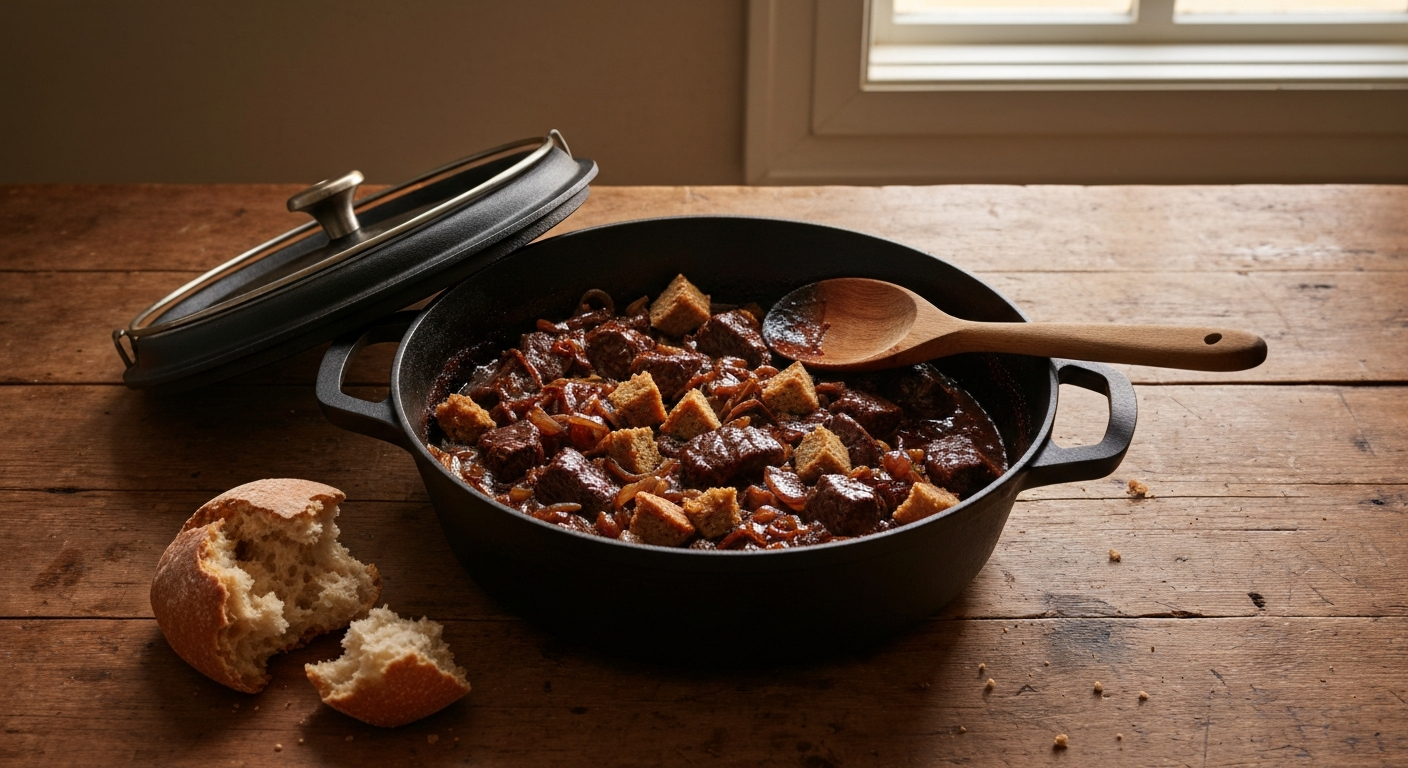
Carbonade flamande is on every brasserie menu in Brussels, from a corner café in Saint-Gilles to the big terraces around Place Flagey, and most people order it without quite knowing what it is. The short version: beef braised slowly in dark abbey beer with onions and a slice of pain d'épices for sweetness. It is our equivalent of the French boeuf bourguignon, except we use beer instead of wine and refuse to apologise for it. The Brussels version is unhurried and rib-sticking. You make it on a Saturday afternoon while the grey weather does its thing outside, and you eat it on Sunday, or Tuesday, or Thursday. It only improves.
What is carbonade flamande, exactly?
Carbonade flamande (stoofvlees or stoverij in Dutch) is a Flemish-Belgian stew of beef slow-braised in dark beer, sweetened and thickened with onions, brown sugar and a mustard-spread slice of pain d'épices. It predates the tomato in Belgian cooking and is built around one idea: cheap, tough cuts of beef become extraordinary if you give them time and good beer. In Brussels it is the default cold-weather brasserie order, almost always served with fries. If you want the wider context of Belgium's other great comfort plates, our pieces on stoemp, the most Brussels dish you have never ordered and on why the frite is Belgian, not French sit right next to this one.
Why the beer matters more than the beef
The standard mistake is to use lager. Lager makes a thin, bitter carbonade. The right choice is a dark abbey beer with malt sweetness: Westmalle Dubbel, Rochefort 6, Chimay Rouge, Leffe Brune. We use Leffe Brune in the Timesty kitchen because it is reliable and the result is consistent week to week. At home, the slightly better choice if you can find it is Westmalle Dubbel: a touch more body, a touch more complexity, and the recipe forgives the price difference because the rest of the ingredients are cheap. You will find all four on the shelf at any Delhaize or Carrefour in the city, usually for €1.20–€2.50 a bottle.
| Beer | Style | Why it works |
|---|
| Leffe Brune | Dark abbey, 6.5% | Reliable, easy to find anywhere in Brussels, consistent sweetness. Our kitchen default. |
| Westmalle Dubbel | Trappist dubbel, 7% | More body and dark-fruit depth. The best home upgrade if you can find it. |
| Rochefort 6 / Chimay Rouge | Trappist, 6–7.5% | Rich and complex, a touch pricier. Excellent, but save half the bottle for the cook. |
| Pils / lager | Pale lager, ~5% | Avoid. Thin, bitter, no malt sweetness to balance the long braise. |
Pain d'épices is the secret A slice of pain d'épices spread with strong mustard and laid on top of the carbonade in the last 30 minutes is what separates a Belgian grandmother's carbonade from an attempt at one. As it dissolves, the bread thickens the sauce and the mustard cuts the beer's bitterness. Skip it and the dish is fine; include it and the dish becomes itself.
Carbonade Flamande (4 servings)
- 1 kg beef chuck or shoulder, cut into 4 cm cubes
- 750 g onions (about 4 medium), sliced thinly
- 500 ml dark abbey beer (Leffe Brune, Westmalle Dubbel, or similar)
- 2 tablespoons brown sugar or dark cassonade
- 2 tablespoons red wine vinegar
- 1 slice pain d'épices (gingerbread)
- 2 tablespoons strong Dijon or Tierenteyn mustard
- 2 bay leaves, a few sprigs of thyme
- 30 g butter, 1 tablespoon flour
- Salt, black pepper, neutral oil for searing
- Pat the beef cubes dry with paper towel and season generously with salt and pepper. Heat a heavy pot (Dutch oven or cast iron) with a film of neutral oil over high heat. Sear the beef in batches, two or three minutes per side, until deeply browned. Don't crowd the pan; under-browned beef won't recover.
- Remove the beef. Lower the heat to medium and add the butter to the same pot. Sweat the onions for 15 to 20 minutes, stirring often, until they collapse and start to brown lightly. Sprinkle in the flour and stir for one minute to cook off the raw taste.
- Add the vinegar and brown sugar, stir, then pour in the beer. Scrape up everything from the bottom of the pot. Add the beef back in with any resting juices, plus bay leaves and thyme. The liquid should come about halfway up the meat, not cover it; add a splash of water if needed.
- Bring to a low simmer, cover, and cook for 1.5 hours over the lowest heat that maintains a quiet bubble. Stir once every 30 minutes. The beef should be fork-tender at the 1.5 hour mark.
- Spread the mustard generously on the pain d'épices and lay it mustard-side-down on top of the meat. Cover and continue cooking 30 more minutes. The bread will dissolve into the sauce.
- Stir the dissolved bread into the sauce. Taste. Adjust salt and pepper. The sauce should be glossy and coat a spoon. Serve with fries (the traditional pairing), mashed potatoes, or stoemp. A glass of the same beer used in cooking.
What we do differently in the Timesty kitchen
The kitchen version is the same recipe at six times the volume, but we braise it on Wednesday morning in our AFSCA-certified Brussels kitchen and let it rest in the cold room through Thursday and Friday before portioning. A two-day rest is not optional; it is the difference between good carbonade and the kind that makes you remember why this dish exists. If you want to see how that Wednesday actually runs, we wrote it up in a Wednesday inside our AFSCA-certified kitchen. When the carbonade is on the Timesty menu, it lands in your Sunday box across the 19 communes between 14:00 and 18:00, already rested, and you just reheat it. We did the waiting for you.
Which beer is best for carbonade flamande?
A dark abbey or Trappist beer with malt sweetness. Leffe Brune is the reliable workhorse (and what we use in the kitchen); Westmalle Dubbel, Rochefort 6 or Chimay Rouge are excellent upgrades. Never use a pale lager or pils: it makes the stew thin and bitter.
What is the difference between carbonade flamande and boeuf bourguignon?
Both are slow beef braises, but carbonade flamande is Belgian and built on dark beer, onions, brown sugar and a mustard-spread slice of pain d'épices, giving a sweet-and-sour edge. Boeuf bourguignon is French and built on red wine, with bacon, mushrooms and pearl onions. Carbonade is sweeter and maltier; bourguignon is more wine-driven.
What do you serve with carbonade flamande in Brussels?
Fries are the classic Brussels pairing, almost a rule. Mashed potatoes or stoemp work just as well, and a glass of the same beer you cooked with finishes it. Plenty of bread to mop the sauce is never wrong.
Can you make carbonade flamande ahead of time?
You should. Carbonade is better after a one- or two-day rest in the fridge, which is exactly why we braise ours on Wednesday for a Sunday box. The flavours marry and the sauce thickens. It keeps three to four days refrigerated and freezes well for up to three months.
Back to the blog | See this week's menu